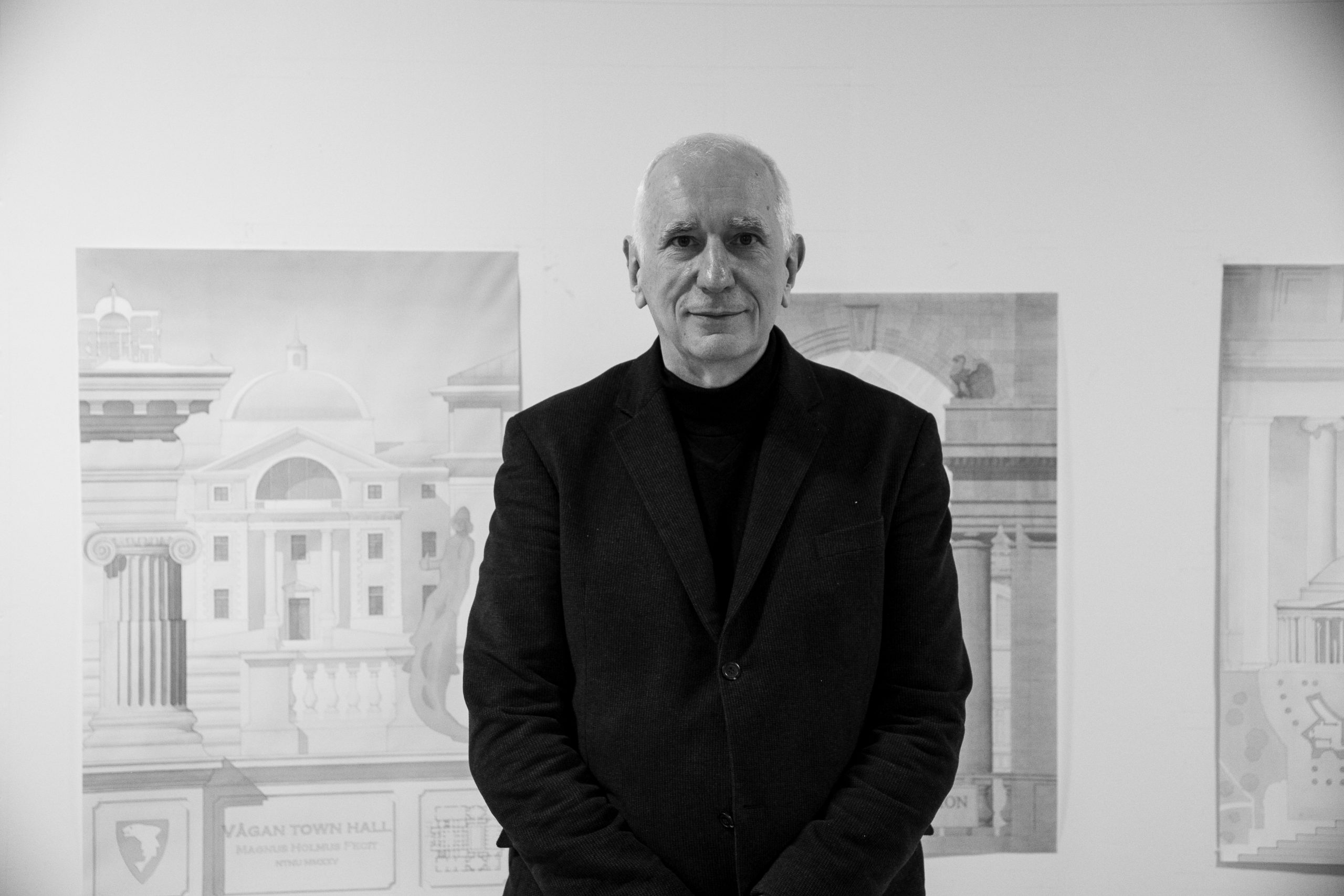
Photograph by Torgeir Holljen Thon, Arkitektur.no
Branko Mitrović
Welcome. I am a professor of architectural history and theory at the Norwegian University of Science and Technology (NTNU), Trondheim, Norway. Since I have a dual background in architecture and philosophy I actively research and publish in both fields. The aim of this site is to make available my works and writings, published and unpublished.
Originally I studied architecture and philosophy at Belgrade University, worked for four years as an architect and passed my professional registration examination in architecture in 1990. In 1992 I started my PhD studies in architectural history at the University of Pennsylvania, where I received an MS degree in 1994 and a PhD in 1996. The topic of the dissertation pertained to Daniele Barbaro’s commentary on Vitruvius. In the period 1994 through 1996 I taught at the University of Notre Dame, first on their South Bend campus and then in Rome. In January 1997 I moved to Auckland, New Zealand where I taught for the next seventeen years at the Unitec Institute of Technology—first as a senior lecturer, then as an associate professor (2000) and as a full professor (2004). During that period I also had post-docs and research fellowships at the Harvard Centre for Renaissance StudiesI Tatti, the Canadian Centre for Architecture, the Technical University Berlin, the National Gallery in Washington DC and the Clark Art Institute. In 2008 I received the Humboldt Forschungspreis for my work in architectural history. During my years in Auckland I also resumed my studies in philosophy and received a PhD in 2007. The topic of the dissertation pertained to Jacopo Zabarella’s interpretation of Aristotle’s De anima. In 2014 I moved to Trondheim, Norway and started teaching at NTNU, where I am still working today.
In architectural history and theory most of my work has concentrated on the study of early modern architectural theory. This work falls into two large groups. My long-term involvement with the classical movement that started in the 1980s entailed a strong interest in the recovery of knowledge about early modern architectural design theory. This interest has motivated, for instance, my studies on Palladio and Vignola. At the same time, my philosophical interests have also affected my work in architectural history through my long-term project on the philosophical background of early modern architectural theories, that resulted in my monographs on Alberti and Guarini.
For the past two decades most of my philosophical interest has been in the field of philosophy of history. Large part of this work pertained to the philosophical problems of the methodology of historical research. My work in the philosophy of the social sciences was also part of the effort to see how historians can do their work without postulating immaterial and abstract entities. In more recent times, I have been increasingly involved in the debate about historical (anti-) realism.
It has taken me a long time to understand that my work in architecture and in philosophy are two sides of the same coin. They both reflect my faith that human intellectual life and creativity are not reducible to or determined by one’s participation in a community. In other words, that a human being is much more than a mere member of a group. Through my career, this view has led me to reject architectural modernism, aesthetic conceptualism, “New Look”-type theories of perception, the view that all thinking is language-based, as well as various social holisms and constructionisms. Publications presented on this site predominantly reflect this one concern, that has motivated most, maybe all of my intellectual work through my career. It is probably unnecessary to add that I have no intention to change.