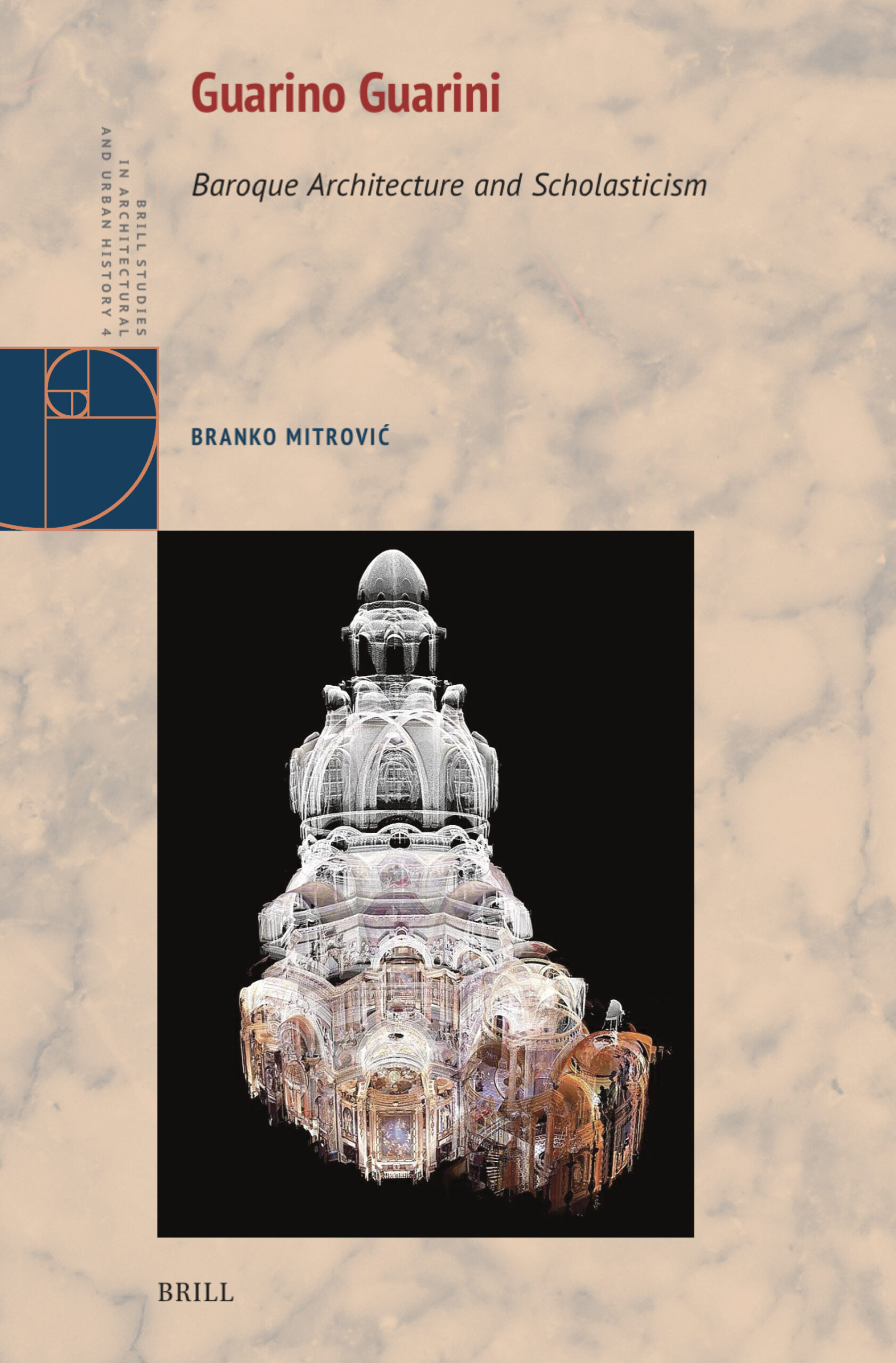
Guarino Guarini. Baroque Architecture and Scholasticism
- Branko Mitrović
- Leiden: Brill, 2025.
Guarino Guarini (1624-1683) is today best known as one of the most prominent architects of the Italian Baroque. However, unlike other major Baroque architects, Guarini was also a polymath who published voluminous treatises on astronomy, mathematics, philosophy and architecture and lectured on philosophy and theology at various educational institutions of the Theatine order to which he belonged. The monograph concentrates on the implications of Guarini’s philosophical views for his architectural theory. The core document for the study of his worldview is his massive philosophical treatise Placita philosophica. In an earlier article I have managed to establish that the book belongs to an entire genre of seventeenth century philosophical books that all share the same structure, the order of topics and survey Aristotelian scholastic philosophy. While it was written as a philosophical treatise, Placita also presents comprehensive perspectives on core problems of architectural theory, such as space and place, the functioning of perception and spatial thinking, the role of human cognition in the attribution of aesthetic properties, symbolism and meanings in architecture and so on. The book is thus a systematic analysis of Gurini’s theoretical views on architecture in the context of his philosophical worldview.
-
Views: 115