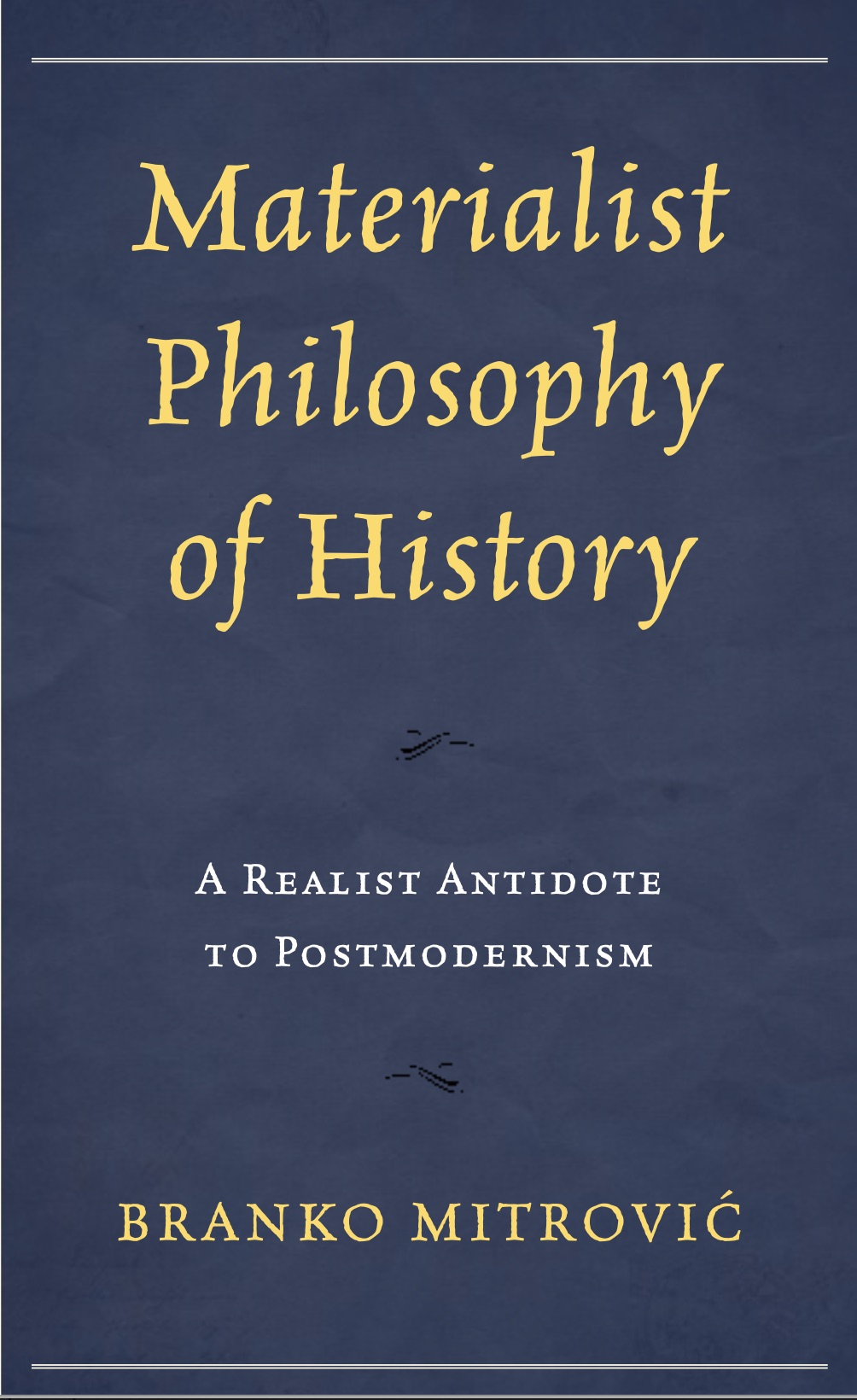
Materialist Philosophy of History. A Realist Antidote to Postmodernism.
- Branko Mitrović
- Lanham: Lexington, 2020.
This book presents a systematic survey of the implications of materialism (or physicalism or naturalism) for research in history and historical humanities. By ‘materialism’ one should understand here the view that everything is physical—that the world consists of elements that physics describes, such as elementary particles, fields, forces, space, time, but nothing else. Mental states, on this account, are biological phenomena, biological phenomena are chemical, and chemical phenomena are physical. In philosophy, there is a long-standing debate about physicalism; outside philosophy, the view that everything is physical is exceptionally widespread in some cultural contexts, and it is probably endorsed by most practicing historians, at least in the English speaking world. At the same time, the materialist (physicalist, naturalist) understanding of how the world works has an exceptionally wide range of implications for historical research and its methodology that have never been systematically analysed in contemporary philosophy of history. Generally speaking, the most important of these implications is the assumption that abstract, immaterial or spiritual substances, forces or phenomena are non-existent and therefore could not have participated in human history. Obviously, few historians today rely on spiritual substances or their own religious views when describing and explaining historical events. Nevertheless, one often reads in contemporary historical writings descriptions or explanations that rely on communities, cultures, history, discourses, and so on that are understood as abstract or immaterial forces with causal capacities that they could not have if the world consisted purely of physical elements. Questions about the ontology and the causal capacities of historical and social entities, forces, or phenomena directly relate to questions about their ability to affect, determine, and ultimately explain historical events and the acting of historical figures. As a result, they directly pertain to more specific methodological questions. For instance, can there be historical or social forces that are something other than (systematic) interactions among individuals? In what ways can historical contexts affect or cause decisions and actions of historical figures? What about their mental states and beliefs? When can a historian claim that certain views were inconceivable to members of certain historical communities? The materialist paradigm precludes the possibility that the contents of the mental states of historical figures could have abstract immaterial existence, and this has wide-ranging consequences for the way historians can attribute beliefs or concepts to historical figures, as well as for the understanding, interpretation, and translation of documents. Finally, materialism has direct consequences for the well-established debate between realism and constructionism in the philosophy of history and the dilemma about the transparency versus opacity of historical narratives.