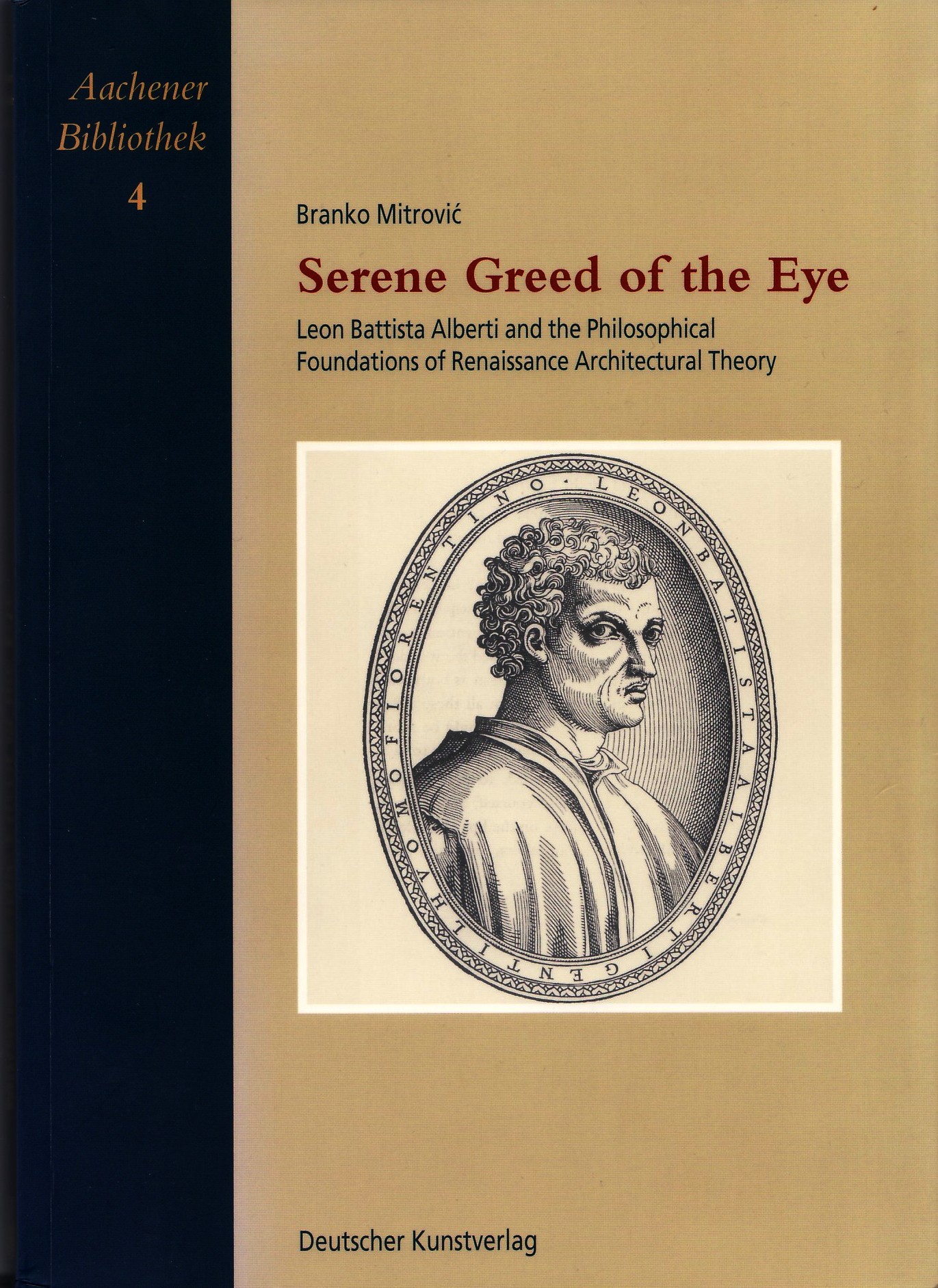
Serene Greed of the Eye. Leon Battista Alberti and the Philosophical Foundations of Renaissance Architectural Theory
- Branko Mitrović
- Berlin: Deutscher Kunstverlag 2005.
The book analyses the philosophical background of Leon Battista Alberti’s architectural theory. It systematicaly surveys Alberti’s use of his technical terms (lineamenta, concinnitas, spatium, ornamentum, etc.) and analyses their meaning in the context of Aristotelian worldview in which Alberti was educated. The first three chapters discuss Alberti’s use of the term “lineamenta” and show that in all contexts in which the word appears in Alberti’s treatise De re aedificatoria, it can be translated as “shape”. It is also pointed out that the Aristotelian context in which Alberti worked prevented him from using words such as “forma” or “figura”. Chapter Four deals with Alberti’s concept of space. Chapter Five discusses Alberti’s views on beauty and argues for a formalist reading of his architectural theory. It also presents systematic analyses of Alberti’s technical terms such as concinnitas and ornamentum. Chapter Six explains, why anachronistic approaches to Alberti, based on the twentieth-century assumption that architecture conveys “meanings” and the idea that architecture represents the human body, fail to provide comprehensive understanding of Alberti’s architectural theory. Chapter Seven deals with Alberti’s views on cognitive psychology that underwrite his conception of aesthetic preference.
-
Views: 110